
In 2026, British Columbia made a historic shift that residents had been discussing for decades: we finally did away with the "spring forward" and "fall back" ritual, opting instead for Permanent Daylight Savings Time (DST). For most, this meant more evening light for after-work hikes and a permanent end to the grogginess of clock-change Mondays.
But for solar owners and those considering the switch, this legislative change introduced a fascinating technical quirk. If you’ve been monitoring your system’s production software, you’ve likely noticed that your "peak" production hour—the moment the sun is highest in the sky—no longer aligns with 12:00 PM.
In the "new" BC, Solar Noon is now at 1:00 PM. At Riverside Energy, our 30-year mission has been to demystify the science of the sun. In this guide, we’re going to break down exactly what this means for your daily energy production, your Net Metering credits, and how you should adjust your "Energy Ninja" habits to match the new rhythm of the province.
Clock Time vs. Solar Time
To understand why "Solar Noon" moved, we first have to understand what it actually is. Solar Noon is the moment when the sun reaches its highest point in the sky for your specific longitudinal location. Historically, humans designed "Standard Time" so that 12:00 PM roughly aligned with this astronomical event.
However, by choosing Permanent Daylight Savings Time, BC has effectively moved our clocks one hour ahead of the sun’s natural position.
- Under Standard Time: The sun is highest at 12:00 PM.
- Under Permanent DST: The sun reaches that same peak at 1:00 PM.
Does this change your total energy production? The short answer is: No. Your solar panels don't have a watch. They don't care what time your microwave says it is. They only care about photons hitting the silicon. Your system will still produce the exact same amount of total kWh over the course of the day. However, the window in which that energy is produced has shifted on your app’s graph.
The Shift in the "Golden Window"

If you are a high-efficiency homeowner, you likely practice load shifting—running your dishwasher, laundry, or EV charger during peak production hours to maximize your direct solar use.
With the shift to permanent DST, your "Golden Window" of peak production has moved:
- Old Peak Window: 10:00 AM – 2:00 PM
- New Peak Window: 11:00 AM – 3:00 PM
If you have programmed your smart appliances or EV chargers to start at noon thinking that was the peak, you are now starting them an hour "early." While this might seem minor, for systems with slight shading issues in the morning, moving your heavy loads to start at 1:00 PM ensures you are capturing the absolute maximum "free" energy from your roof before drawing from the grid.
Why This Matters for Your BC Hydro Bill
In 2026, BC Hydro’s tiered pricing and Net Metering program remain the bedrock of your solar ROI. Because we are now permanently an hour ahead, your evening energy usage—when you get home from work and turn on the lights, stove, and TV—will now align better with the tail-end of solar production in the spring and summer.
Because the sun "stays up" an hour later according to our clocks, you are more likely to cover your 5:00 PM to 6:00 PM energy needs with direct solar power rather than pulling from the grid. This "Direct Consumption" is the most efficient way to use solar because you avoid the small administrative "Rate Rider" fees associated with pulling power back from the grid later.
Adjusting Your Monitoring App
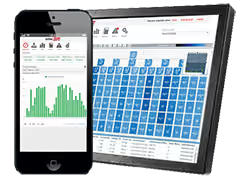
If you use the Riverside Energy monitoring portal or apps like Enphase or SolarEdge, your daily production graph will now look a bit "lopsided" to the right.
Don't panic if you see low numbers at 8:00 AM. Under permanent DST, 8:00 AM is "astronomically" 7:00 AM. Conversely, you will see surprising strength in your production numbers at 7:00 PM in the summer. Your system isn't underperforming in the morning; it’s simply following the sun while our clocks follow the legislature.
The Riverside Professional Review
Since 1995, Riverside Energy has been the trusted voice for BC homeowners. We treat every technical shift as an opportunity to educate.
- Respect the Science: We design our arrays based on astronomical data, not clock time. Your system was already "future-proofed" for this change.
- Assurance of Performance: We ensure your inverters are updated to the correct 2026 time zone settings so your reporting data remains accurate.
- Care for the Details: If you have an East-facing or West-facing roof, this shift might actually slightly change your "Self-Consumption" strategy. East-facing roofs will feel like they start "later," while West-facing roofs will become your evening powerhouses.
Strategic Insight: The "Energy Ninja" Tip
To maximize your ROI in the new permanent DST era, set your "Timer Appliances" (Dishwashers/Dryers) to start at 1:00 PM. This aligns your highest demand with the new "Solar Noon" peak, ensuring you use the most expensive "Step 2" energy from your own roof first.
The Riverside Professional Difference
Since 1995, Riverside Energy has been advising BC's commercial and residential leaders with professional engineering and an unsurpassed work ethic. We treat every job like a "showpiece," ensuring that the structural engineering, electrical integration, and technical documentation are handled with precision.
In 2026, the sun hasn't changed its path, but BC has changed its pace. The question is no longer "If," but "When" you will align your life with the power of the sun.
At Riverside Energy, we don't just install panels; we engineer independence. Stop chasing the clock and start banking the sun.


.webp)
.webp)
.webp)
.webp)